What Jools Holland Can Teach the Church?

Posted on: 24/05/2011
Jools Holland at Somerleyton Hall, Suffolk

photo: Tim Parkinson

I enjoy Jools Holland for his ability with Blues piano, and to a lesser extent his Big Band showiness. What I like even more is his signature TV show, Later… with Jools Holland, where each week he assembles an impressive breadth of different artists, drawing in some big names, veteran performers and showcasing some new talent, and manages to craft a sense of common purpose out of what often seems an odd assortment.

The relevance of this is that Music is often tribal, with most of us fixing on a relatively narrow range of genres, with which we find ourselves comfortable. With the Later show, there is an anarchic sense of juxtaposition, out of which comes an odd sense of coherence.

And here is the parallel with the church. In all honesty, we in the church also tend to gravitate to a style of worship and a group of people with whom we are comfortable. Given what St Paul wrote about the essential variety within the church this is not ideal, though at a social level this is of course natural enough. The danger is that we so easily become ‘mono-cultural’. Which makes those churches which are able to bring together diversity in community all the more impressive.

In the late 1980s I lived and worked in Islamabad, the capital of Pakistan. I was there to build (bricks and mortar) St Thomas’ Church. Buildings aside, as an expression of the body of Christ St Thomas’ was hugely impressive in holding together the full breadth of that society, from the illiterate street sweepers, through the educated Pakistanis – who might be cooks or drivers or engineers or military officers – to the foreign mission partners, aid workers and diplomats. The church had services in 3 languages – Panjabi, Urdu and English – each meeting at different times; but it had one PCC and events (including a church weekend away) were orgainsed that combined all three congregations. Clearly this was not all straightforward, but no other institution in Pakistani life could get close to holding together that social breadth.

St Thomas' Church, Islamabad

St Thomas’ Church, IslamabadPhoto: Peter Parish

So what sort of a building could serve such a diverse range of people? In shape the main worship space is cruciform; but the form is certainly not English neo-Gothic, which was the first thought of many in the church, on the basis that most of the churches there were built by the British. The church is of its place – using skills and a design language that draws on Moghul architecture of patterned brickwork – but also challenges its place.

I think Jools has much to teach us – in his ability to take a diverse range of performers and articulate a compelling narrative, in his case in live performance, even getting chalk and cheese to play together.

 

Are you going to the Christian Resources Exhibition?

Posted on: 03/05/2011
Christian Resources Exhibition Logo

The CRE gathers together an amazing range of Christian organisations, from charities to literature, from furniture to clothing – the list is endless. The exhibition is a great opportunity to reflect on church life and faith, to be stimulated with new ideas, and to meet others.

We are delighted to say that we are taking part in this year’s Christian Resources Exhibition at Sandown Park Racecourse near Esher, which runs from Tuesday 10th to Friday 13th May.

Having exhibited successfully at CRE Peterborough in February we see this as a great place to explore the themes we are championing through this site. Our stand is P64 in the Pavillion – see our ad on the inside back cover of the exhibition handbook. Lots more information on the exhibition is available at www.creonline.co.uk; click on ‘What’s On at Sandown 2011’.

I would recommend you attend CRE if you are responsible for any aspect of the life of your church, from leading it to making the coffee…

We look forward to seeing you there!

What can we learn from the story of Nehemiah…?

Posted on: 05/04/2011

When asked what the Bible has to say about buildings, the first thing I say to them is read the book of Nehemiah – if you are considering a building project, a lot of what you’ll need is in there.

Nehemiah is required reading for churches embarking projects because he had many of the same problems many churches face, but of course there are also some important differences. When we read the story, we often focus on the opposition Nehemiah faced. It may be tempting to equate Sanballat and Tobiah with planners, conservation officers etc, but the nature of this opposition was specific to Nehemiah’s political context. On the other hand we can be assured that there will be ‘friction’ – this may come in the form of inertia and apathy, or bureaucracy, or Nimbyism, or the not inconsiderable matter of having a great deal of money to raise.

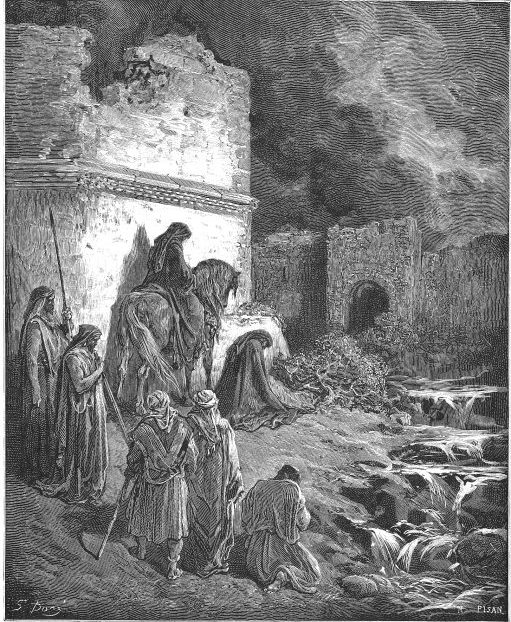
Nehemiah surveying the walls of Jerusalem

Nehemiah surveying the walls of Jerusalem

Perhaps the biggest issue that is transferrable from Nehemiah’s story to the present day concerns change. Be aware that as soon as you contemplate a building project you are in the business of change. Change is hard; indeed some people build their lives around avoiding it, seeing it as all threat. Others of a more entrepreneurial spirit embrace change, seeing it as all opportunity; most of us are somewhere in the middle. I see Nehemiah in the second group; we could call Nehemiah a ‘Merchant of Change’.

The call of God in scripture is usually out of one thing into something else, something that brings change for the individual and for those around them. I have yet to find the place where God says: “Behold, I do an old thing…!” God is a God of effervescent new creation.

So if we are to put ourselves in the way of change, we should be prepared for friction from those who are less comfortable with it. When faced with change, people generally see only the loss involved; often it is only when the new creation, whatever that may be, is complete that we see the benefits. Which is why a successful church building project will need an architect who is thick skinned enough to take the brunt of the pain, while articulating a coherent vision and telling the story of the new creation. For building project it helps a great deal if that story is articulated with the help of a 3D computer generated walkthrough, which gives stakeholders a means of engaging with the future benefits.

So if you haven’t done so recently, re-read Nehemiah. If you like, post a comment – particularly on the uses and abuses of Nehemiah’s story – or give me a call if you have anything you would like to discuss.

My church is listed so I canʼt change anything, can I?

Posted on: 15/02/2011

photo: Natalie MaynorThat is almost never the case! The key thing is to understand the heritage value of the building and its fittings, and make the case for change in light of that. One needs to start from an understanding of why the building is listed, and to what grade (in increasing order of importance the grades are 2, 2* or 1); 90% of listed buildings are grade 2. And then one needs to understand the impact of any proposed changes on the heritage value of the building.

The established denominations (Church of England, Baptist Union, Methodist etc) enjoy what is called ‘Ecclesiastical Exemption’ which means that Listed Building issues are dealt with by the church authorities (Diocesan Advisory Committee, Baptist Union Listed Building Advisory Committee etc). Generally these folk are sympathetic to your aims, provided you can demonstrate that you have thought them through. For other churches, and where the proposals involve an extension of any kind, the Local Authority Conservation Department will also have a say.

Histon Baptist Church was listed during the course of the building project; because the building is unusually ornate for a Baptist church this did not come as a great surprise. The practical implications of this were:

  • another round of permission-seeking was needed from the Baptist Union Listed Building Advisory Committee; this took several meetings and quite some time.
  • some existing fittings needed careful reuse within the building, for example a stone pulpit which was moved and a selection of the pews.
  • the church was able to reclaim the VAT on the alteration works (but not on repairs and maintenance).

So it was not all bad news by any means, and crucially the main thrust of the scheme – creating a prime venue with flexible open space, new lighting and AV equipment – was successfully achieved.

Photo credit: Natalie Maynor

Am I stuck with these Victorian pews?

Posted on: 15/02/2011

Pews at Histon Baptist ChurchProbably not, is the surprising answer. I’m a big proponent of taking out the pews because it can revolutionise the usefulness and the feel of the church space.

Some points to consider:

  • Were the pews designed for the building or, as was often the case, were they bought from a catalogue? The Victorians tended to cram as many pews into churches as they could, because there were subsidies to encourage this! In most cases these were mass produced and of little architectural merit, so can more easily be removed.
  • Is the church listed? If so, you will need permission for changes to the fixed furniture.
  • When were the pews installed, and have they already been moved around? Some homework here can help a great deal in making the case for change.

Clearly there are some churches where you are stuck with the pews – for example if the pews are medieval, or are an integral part of a very special and particular design. In most other cases there is scope for making changes. The key thing is to do the appropriate research and then make a good case for the change.

At Histon Baptist Church, which is a listed building, all the pews were removed; these were original to the Edwardian building but were of cheap construction. Having taken them all out, some pews were stripped and refinished and then put back around the edges, leaving the main part of the space beautifully open.

Coupled with a newly levelled natural oak floor and underfloor heating the space has been transformed. Here the Listed Building Committee asked us to retain 15-20% of the originals; the remainder were sold or given away.

There is also a ‘political’ issue, which is that not everyone likes change – many people are very fearful of it. There are many village parishes where those in the community feel a sense of ownership of ‘our’ church, even if they never darken its doors. These folk should not be ignored, and their concerns need sensitive handling – ignore them at your peril!

First steps

Always start with some historical research, and arrive at an assessment of how important the pews are to the significance of the building as a whole. You should already know this if you have prepared a Statement of Significance; if not, now is a good time to write one.

If you want to get a feel for the additional space you could create, you could consider temporarily removing a section of pews, perhaps for a specific event. Often existing pews can be ‘unbolted’ and moved into storage – this makes it easier to focus people on the benefits that the change will bring.

« Newer Posts